
Roofers in Bognor Regis
Roof repairs and re-roofs across West Sussex
We repair, replace and maintain domestic and commercial roofs across Bognor Regis and West Sussex. We find the cause, photograph it, say plainly whether it is a repair or a new roof, then price it in writing.
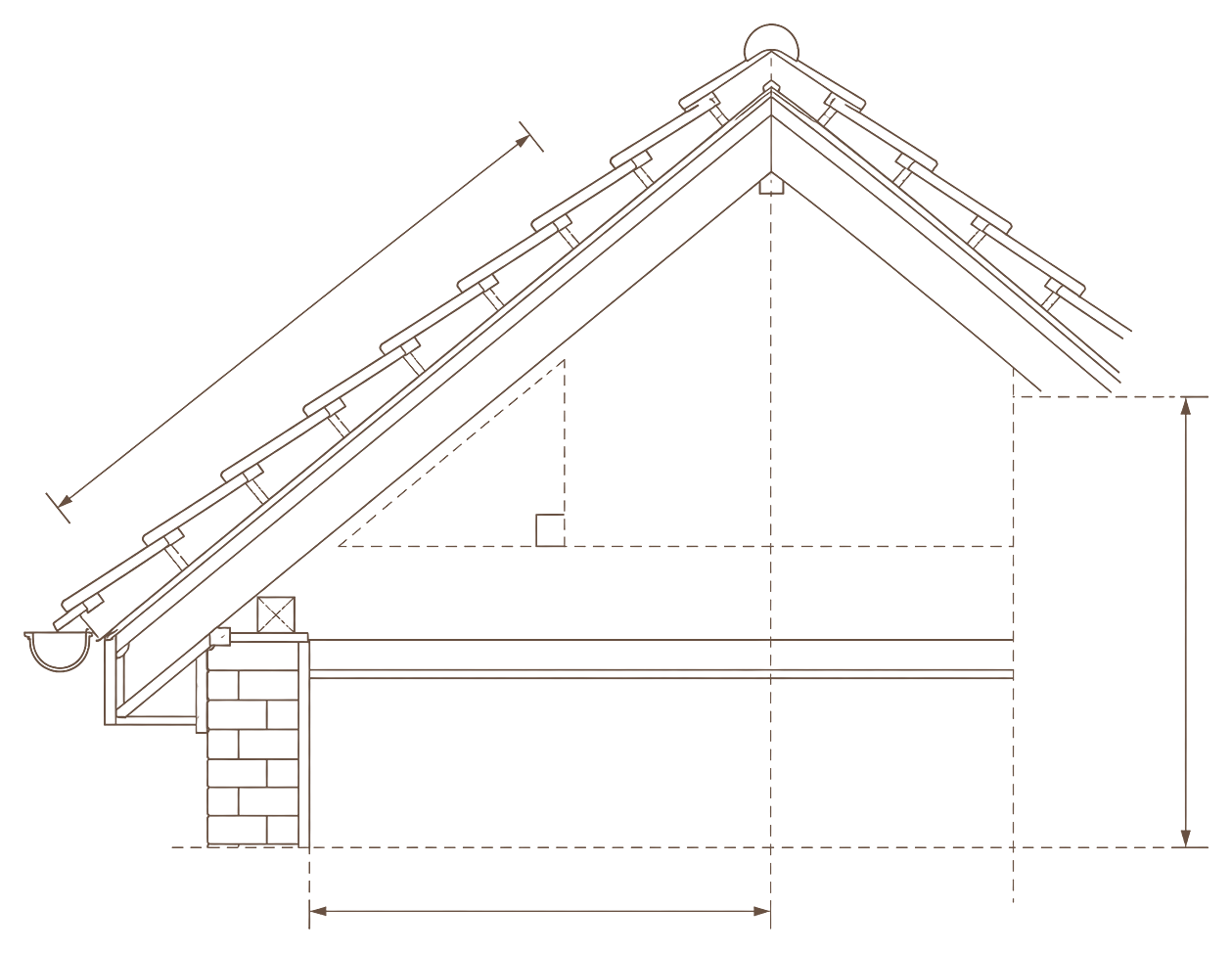
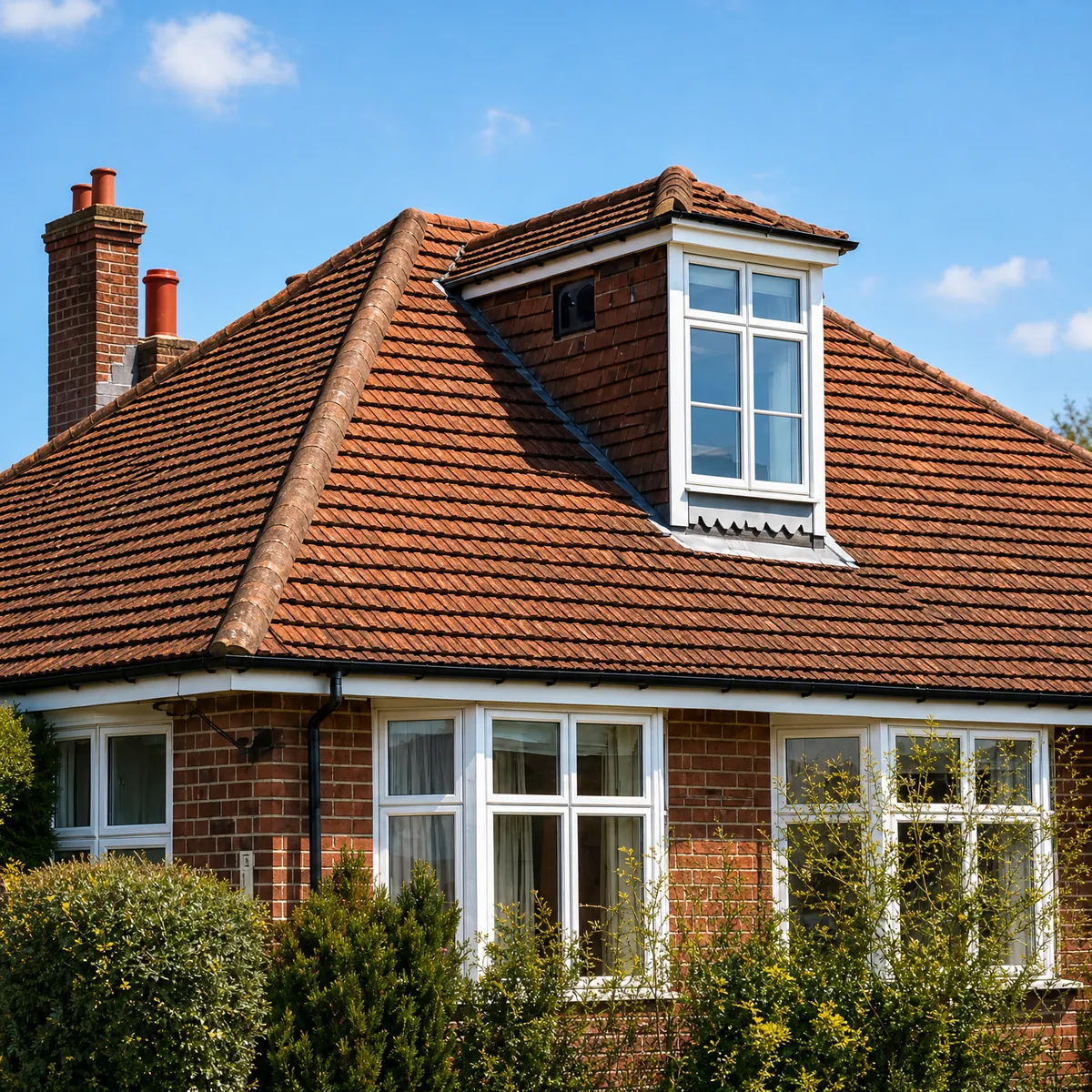
- Repair or replace,
said plainly - Photos of
your own roof - Written quote,
one total price - Ridges and verges
fixed to BS 5534
First, the verdict
Repair, patch or replace your roof?
Repair
One fault, found and fixed, on a roof that is otherwise sound.
Patch for now
A safe, dry temporary fix while you plan and budget the larger job.
Replace
Only when the wear is general, and we show you why in photographs.
Services
Roofing services in Bognor Regis
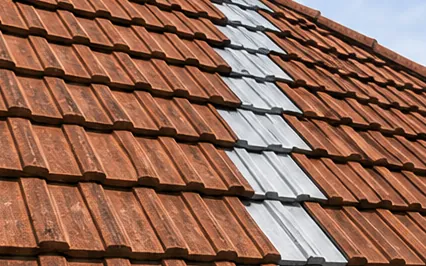
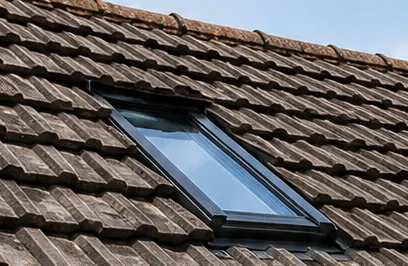
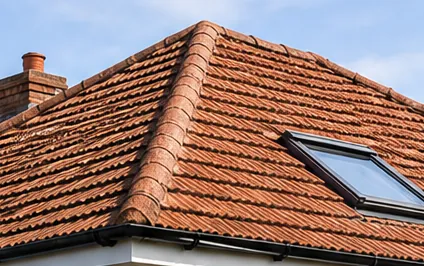
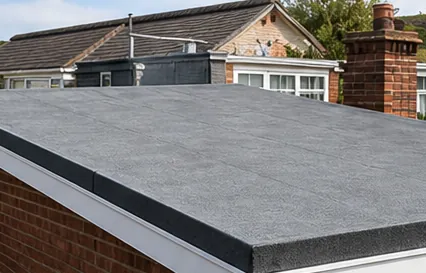
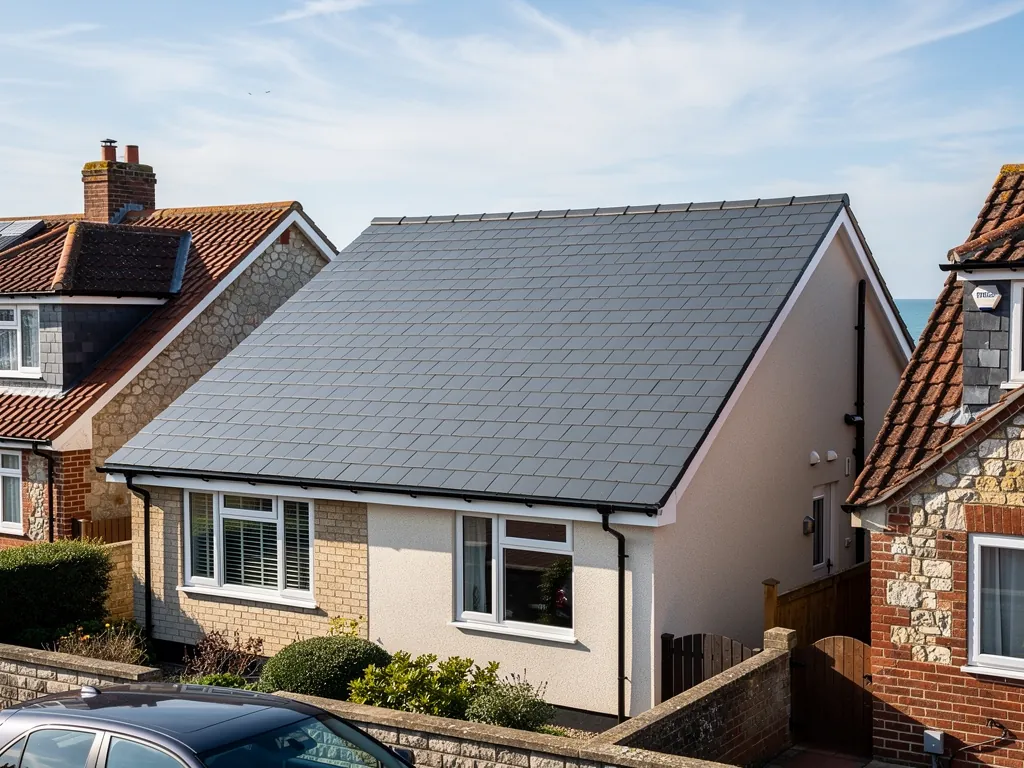
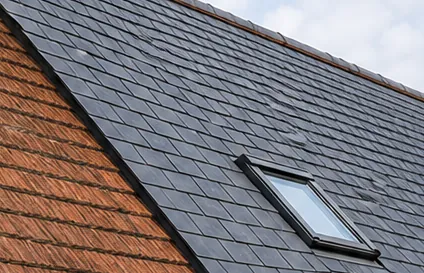
Our commitment
What you can hold us to
- Photographs of your own roof with every quote
- The smallest job that properly fixes it
- Ridges and hips mechanically fixed to BS 5534
- Flashings dressed in lead, flat roofs laid to falls
- Site cleared and the waste taken away
How it works
- 1Call, WhatsApp or send the formSay what you can see; add a photo.
- 2Survey and photographsWe find the cause and photograph it.
- 3One written priceA plain verdict and one total.
- 4The work, then a final checkThen the site is cleared.
The Bognor Regis roof guide
How a local roofer reads your roof
What we look at, what fails on this coast, what the work costs and which rules apply, set out before any price.
Chapter 1: How we read a roof before quoting2013
Sheet 01 / 08Every quote starts with the cause of the problem, found and photographed, because the cause decides whether a repair will hold.
A roof repair only lasts if it fixes the cause, and the cause is often some distance from the wet patch on your ceiling. Water runs along a batten (the timber lath each tile hangs on) or down the underlay (the membrane beneath the tiles) before it drips. A stain over the landing can start at a cracked ridge tile or a valley two metres away. We trace the route first, photograph it so you see what we saw, and the written quote follows.
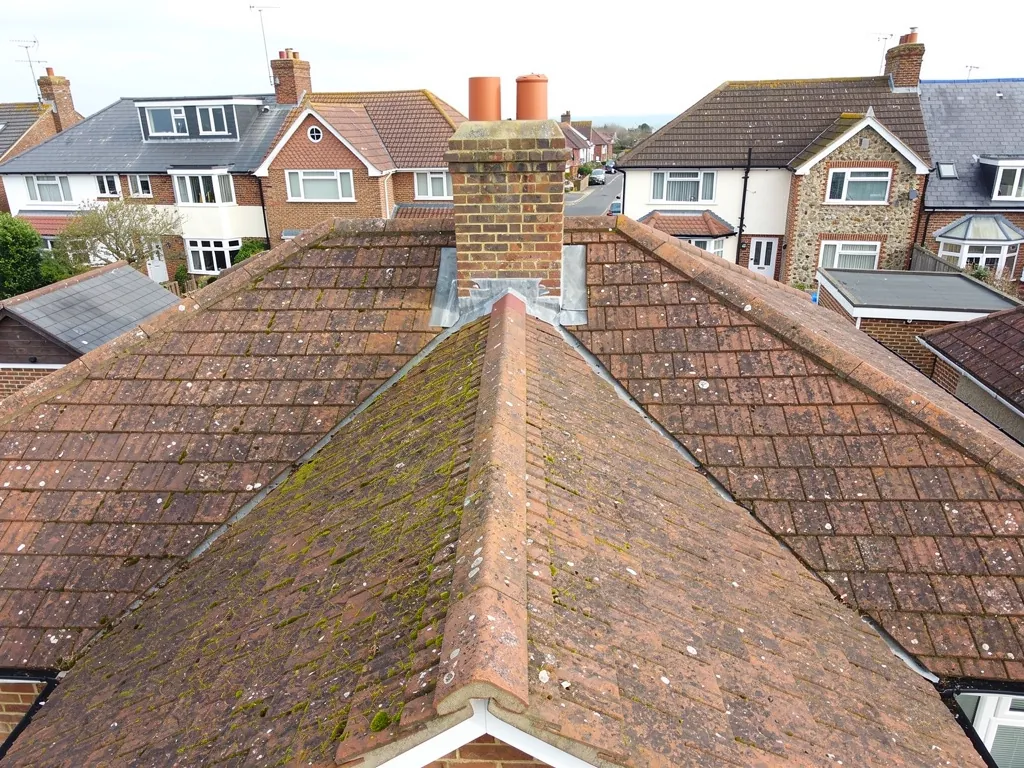
A wet patch on the ceiling tells you water got in, never where it got in.
What the survey covers
- 1LoftWater marks on rafters, insulation and the membrane.
- 2Ridge and vergesBedding, fixings and any loose capping tiles.
- 3Chimney stackBrick joints, the pot collar and the base lead.
- 4GuttersFalls, outlets and the board behind them.
1.1 Inside first, then outside
If we can get into the loft, we start there. Daylight through the tiles, damp timber, a tide mark on the underlay or rusted nail heads tell us where water has been and roughly how long it has been coming in. From outside we look along the ridge, at each verge (the edge of the roof at a gable end), around the chimney and along the gutters. On a bungalow much of this can be seen from a ladder. On a two-storey house a camera on a pole, or a closer look from the roof itself, fills the gaps.
1.2 The verdict comes with its reasons
Once the cause is known, the call is usually plain. A few slipped tiles, a cracked ridge or a tired flashing (the strip, usually lead, that seals the join between roof and wall) is a repair. A roof where the battens are soft and the underlay has perished across a whole slope is not, however neatly it is patched. Where a roof sits between the two, we tell you, and explain what a patch buys you and what it will not. You decide with the evidence in front of you.
The photographs matter because you can show them to anyone. A second roofer, a surveyor, your insurer or a relative can see the same slipped tile or split lead without climbing a ladder. That keeps the conversation about your roof rather than about who sounds most certain, and it turns the repair-or-replace decision into something you can check for yourself.
Chapter 2: Where coastal weather gets into a roof2318
Sheet 02 / 08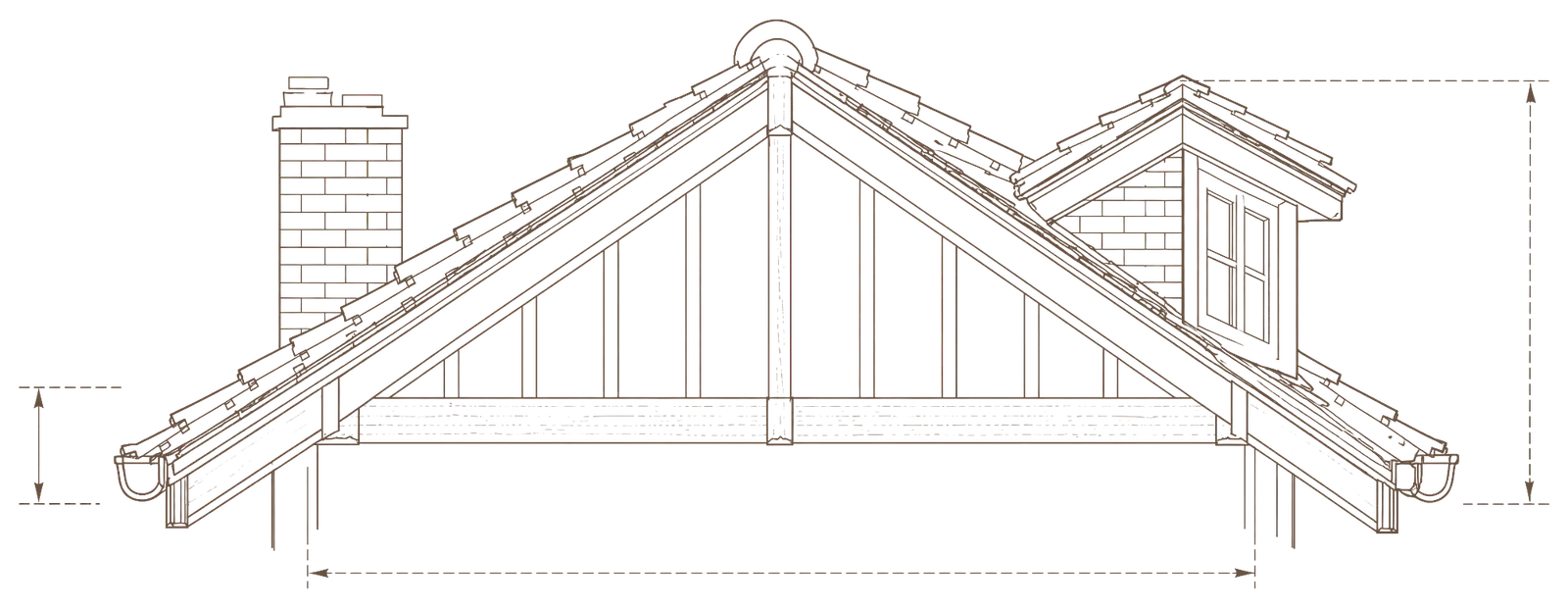
- Ridge Capping tiles meet the wind first.
- Eaves Ventilation gaps and the first course of tiles.
- Dormer cheek The side wall of a dormer, sealed to the slope with lead.
- Valley Water from two slopes gathers in one channel.
- Gutter outlet Leaves and moss here back water up under the tiles.
Near the sea, gales drive rain sideways, so it finds the edges and joins of a roof long before the middle of a slope.
Bognor Regis sits low and close to the Channel, and its weather comes in off the water. Rain driven by a gale does not simply fall on a roof; it is pushed up under laps and into joints. That is why the same few places fail on house after house: the ridge, the verges, the valleys, the junctions around a dormer and the gutter outlets. The middle of a sound slope of tile or slate rarely leaks on its own.
Two ways to hold a ridge
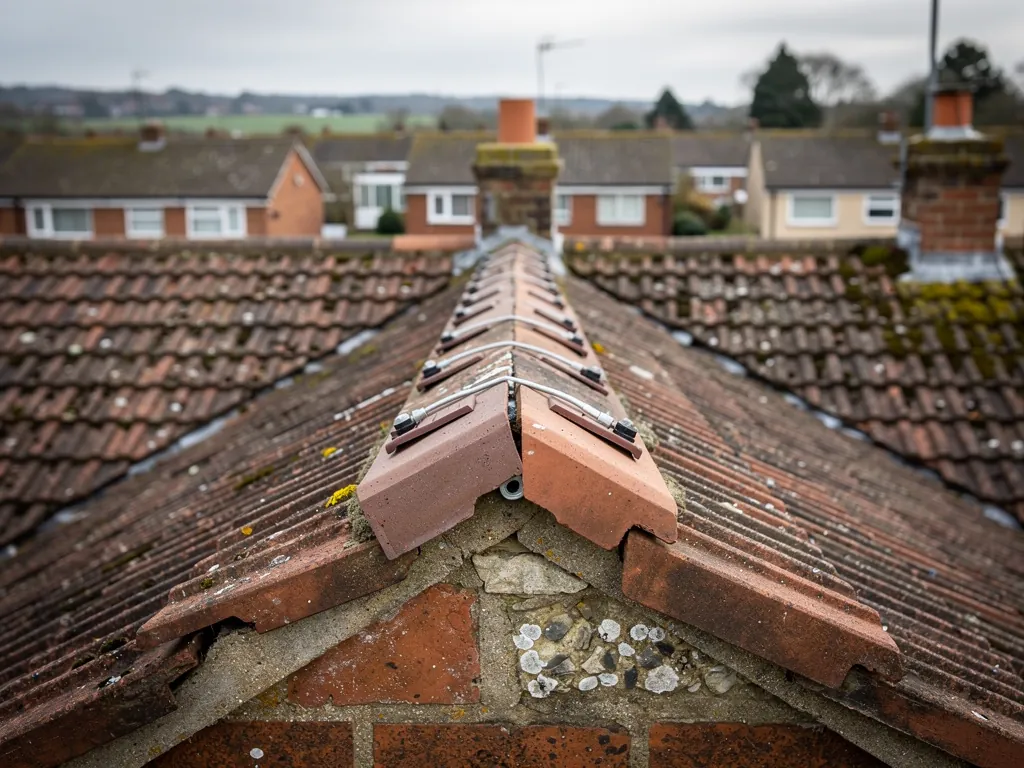
Bedded and fixed
Laid on mortar, with each capping tile also screwed or clipped to the timber below.
Dry-fixed
No bedding mortar at all; a tested kit of clips, seals and a vented roll holds the ridge.
2.1 Ridges, hips and the mortar question
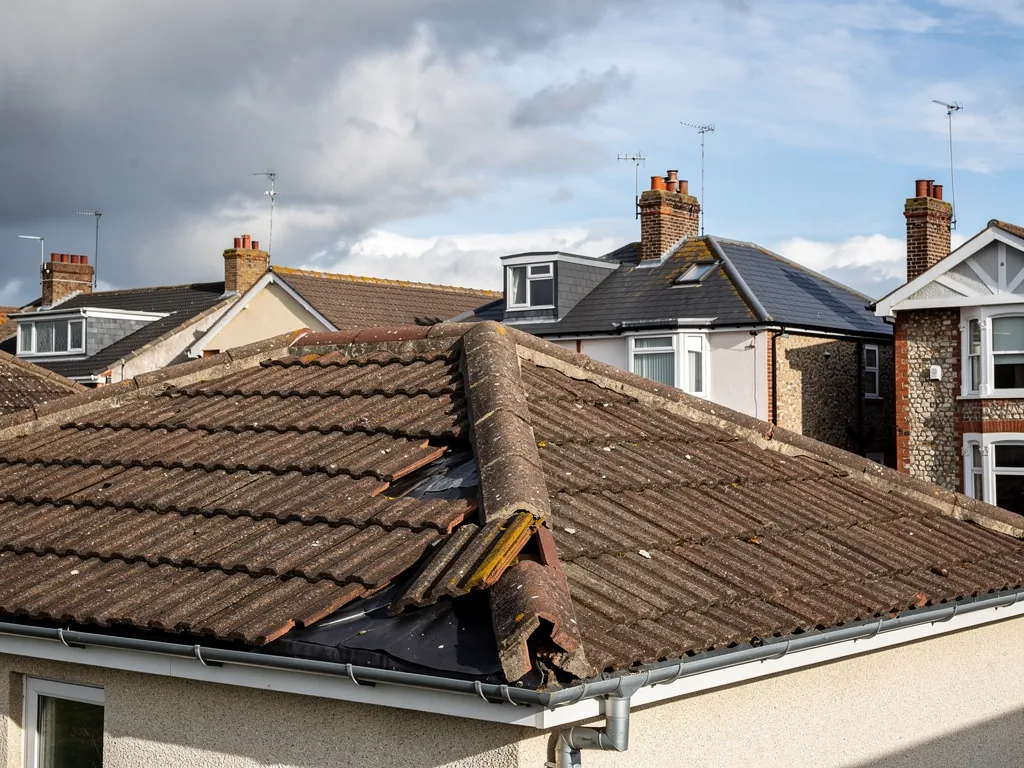
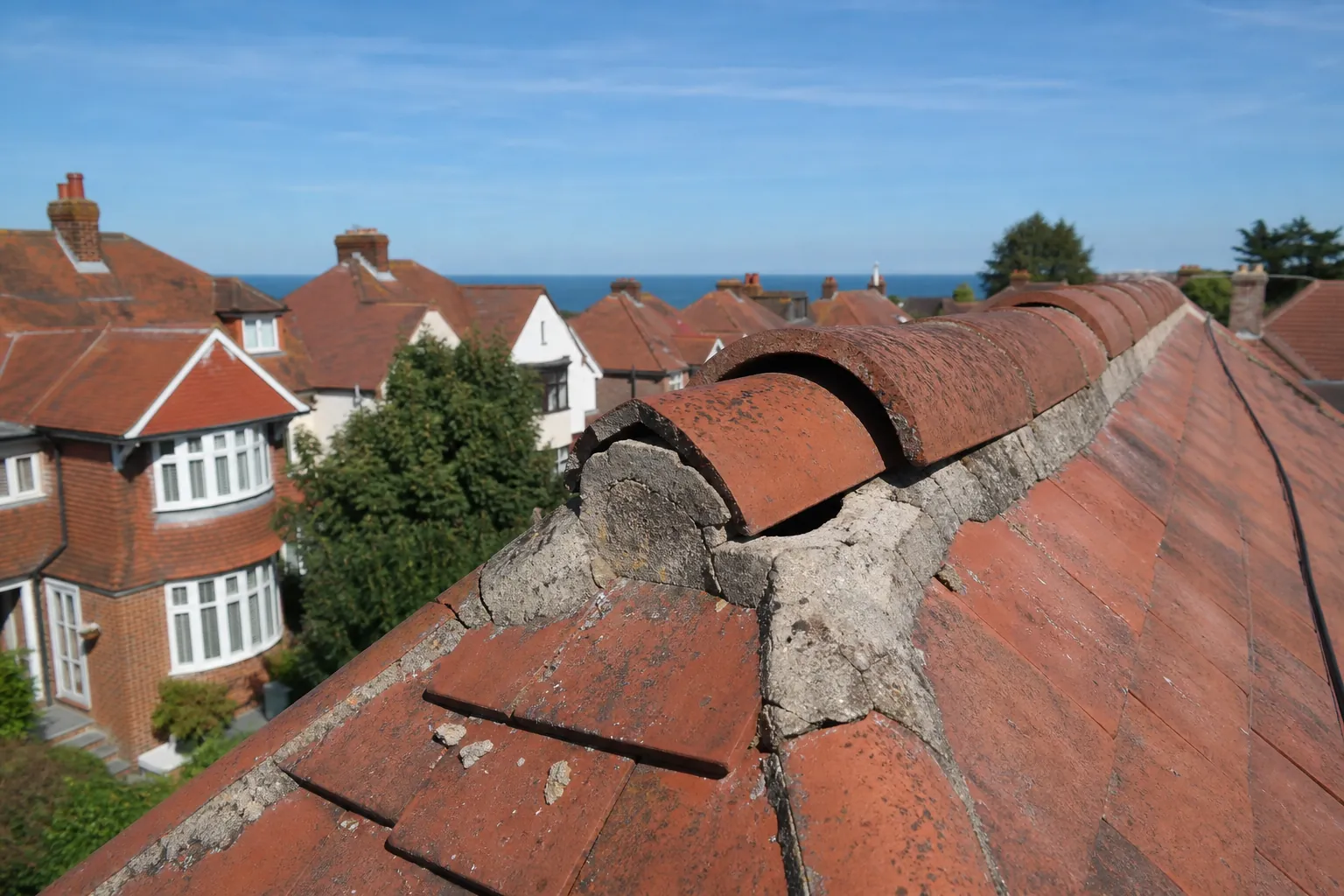
The ridge is the row of capping tiles along the top of the roof; a hip is the sloping ridge where two slopes meet at an outside corner. For generations both were held by mortar alone. Since the 2014 revision of BS 5534, the code of practice for slating and tiling, mortar is not relied on by itself for ridge and hip tiles: they are mechanically fixed as well, with screws or clips, or with a dry-fix system tested to BS 8612:2018. Bedding that has cracked lets water in and lets tiles lift in a blow, so when we rebed a ridge we fix every tile. Our ridge tile repairs page sets out both methods.
2.2 Verges, valleys and low pitches
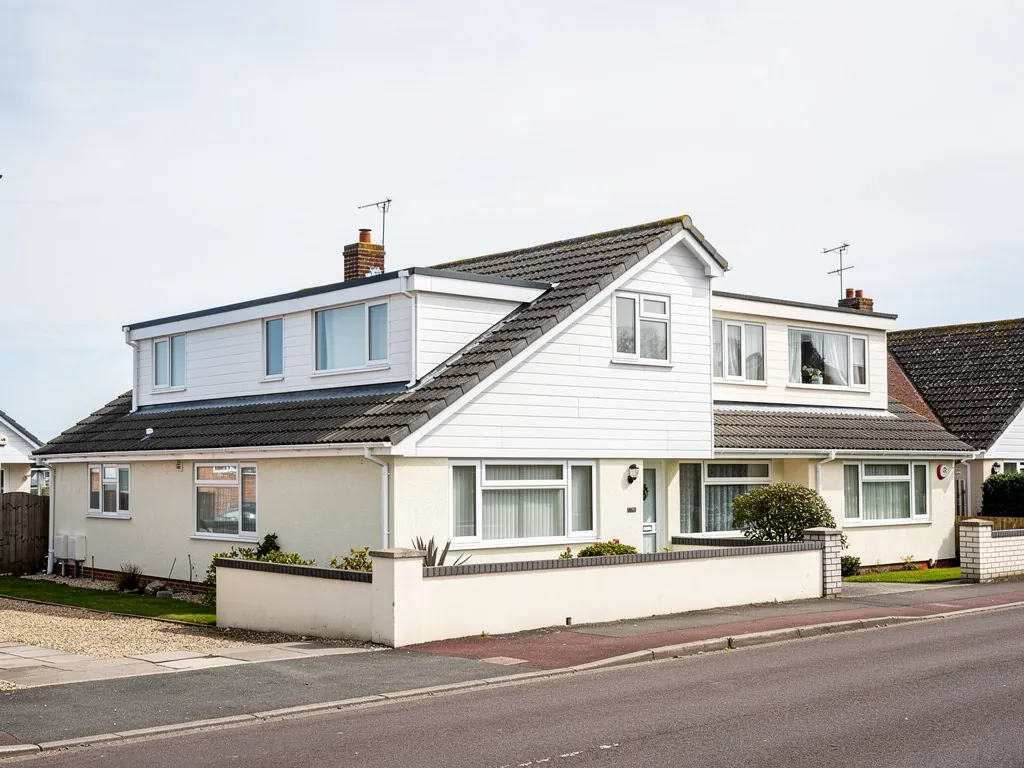
At the verge, mortar pointing on the windward gable dries, cracks and washes out. A valley, the channel where two slopes meet in an inside corner, carries water from both, so a blocked or split valley overflows quickly. Low pitches need extra care. Marley notes that where the pitch is under 30 degrees the windward slope can come under strong suction, which is why fixing specifications are worked out for each roof's location and exposure rather than copied from the last job. Driven rain also works in at the dormer cheeks, the short side walls of a dormer clad in tile or lead, where soakers and flashings meet the main slope. On a chalet bungalow, with dormers and valleys close together, that junction is one of the first places we look.
Chapter 3: Bognor Regis roofs, from seafront slate to chalets3050
Sheet 03 / 08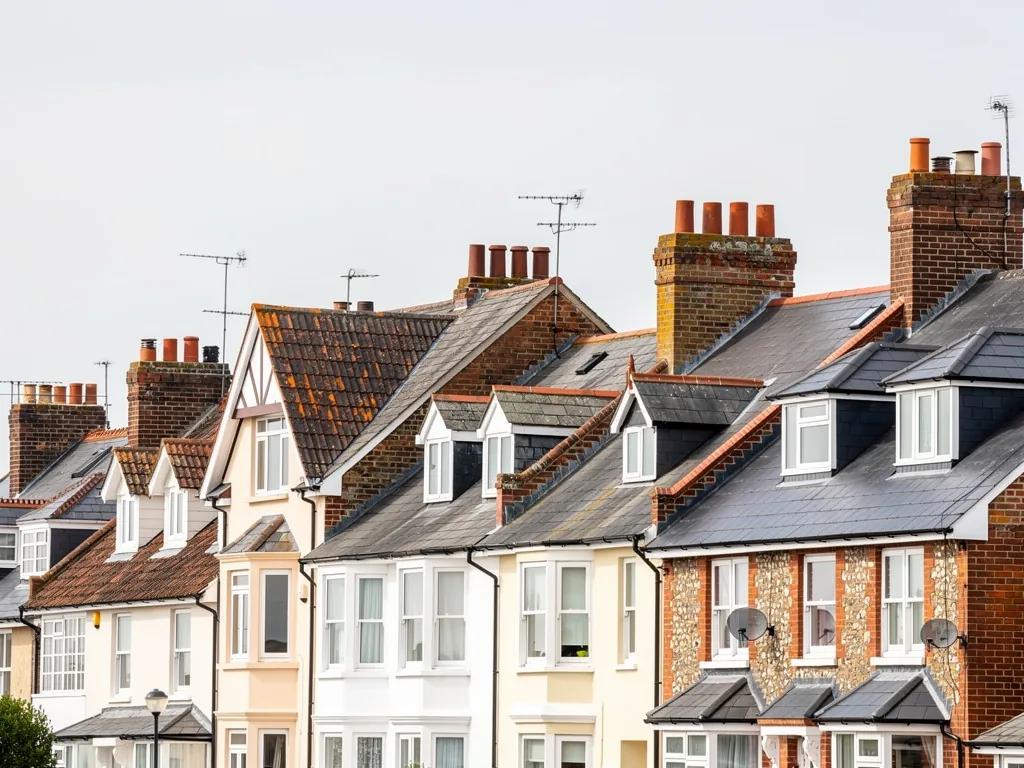
Each era of Bognor’s building left its own roof: slate by the sea, clay tile inland, felt on later extensions.
We work as a local roofer across Bognor Regis and its villages, and the town’s history shows on its roofs. The oldest buildings go back to Sir Richard Hotham’s plan of the late 1700s to make Bognor a resort; Arun District Council dates Nos. 45 and 47 Upper Bognor Road to about 1787. Each later wave of building brought a different covering, and each needs repairing in its own way. Knowing which era a house belongs to tells us what is likely to sit under the covering before a single tile is lifted.
3.1 Regency and Victorian seafront
The Steyne dates from the 1820s: modest two and three storey terraces in stucco, where the council’s appraisal calls the chimneys important features on the skyline. Waterloo Square adds Regency houses from 1815 to 1820, and Aldwick Road has Victorian and Edwardian terraces of stucco, slate and flint. Arun’s guidance notes that slate on Aldwick Road has commonly been replaced with modern concrete interlocking tiles, and for The Steyne it encourages putting back natural slate or plain clay tiles. The Steyne and Waterloo Square was designated a conservation area in August 1979 and extended in July 1994; Aldwick Road followed in July 1994. On these streets a change of covering is worth raising with Arun District Council’s planning team first.
Noted on an older Bognor house
- Original covering or later replacement
- Condition of each chimney stack
- Age of the soffit boards
- Felt extensions and garage roofs
- Any change of covering planned
29
Conservation areas in Arun District, per the council
A Regency terrace and a 1970s bungalow fail in different places and need different fixes.
3.2 Interwar estates, chalets and bungalows
Between the wars the town spread along the shore. Craigweil at Aldwick follows a 1937 layout, in local stock brick under plain clay tiles. Felpham gained cheaper houses in Sea Road in the 1910s, some on stilts against flooding, then its "garden city by the sea" estates; by about 1928 rented bungalows at Middleton-on-Sea were in steady demand. Flansham Park followed in the 1970s. These homes bring hipped tiled roofs, dormers added later and felt-covered extensions and garages. Some interwar houses at Elmer and Southdean had asbestos walls, so on any building put up or refurbished before 2000 we follow the HSE’s advice and assume asbestos until a test says otherwise.
Beyond the town we cover every place within 30 road miles: Selsey and the Manhood Peninsula, Chichester and its harbour villages, Littlehampton, Rustington and Arundel along the Arun, Worthing to the east, and Havant, Hayling Island and Portsmouth to the west, then north through the South Downs to Midhurst, Petworth, Pulborough and Horsham. Inland, West Sussex turns to flint and brick cottages, and each area page describes its roofs.
Chapter 4: Slate, tile, lead and flat roof materials2501
Sheet 04 / 08Each covering has a typical life and a few known weak points, and a good repair keeps to the material already on the roof.
The material on your roof decides how it is repaired, how long a new one should last and what the work costs. Published lifespans are typical figures from manufacturers and trade bodies, never promises, and a roof that is looked after tends to outlast a neglected one. A repair carried out in the wrong material rarely lasts long either. Here is what the main coverings around Bognor Regis are like to live with.
4.1 Slate, clay and concrete tiles
Natural slate is the longest-lived pitched covering we work with: the Confederation of Roofing Contractors says a well-maintained slate roof can last 100 years or more. Its weak point is usually the fixings. When a nail fails the slate slides, and it is refixed with a tingle, a small strip of lead or copper that hooks it back into line. Marley gives clay tiles a minimum life expectancy of 60 years and concrete tiles around 60 years, and stresses that these are expectations rather than warranties. Concrete interlocking tiles are single-lapped, and Wienerberger notes that every single-lap tile needs at least one mechanical fixing. Clay plain tiles on the interwar estates are smaller and double-lapped, often hung on battens that have outlived their nails. See our slate roofing page for re-slating.
Two flat roof choices
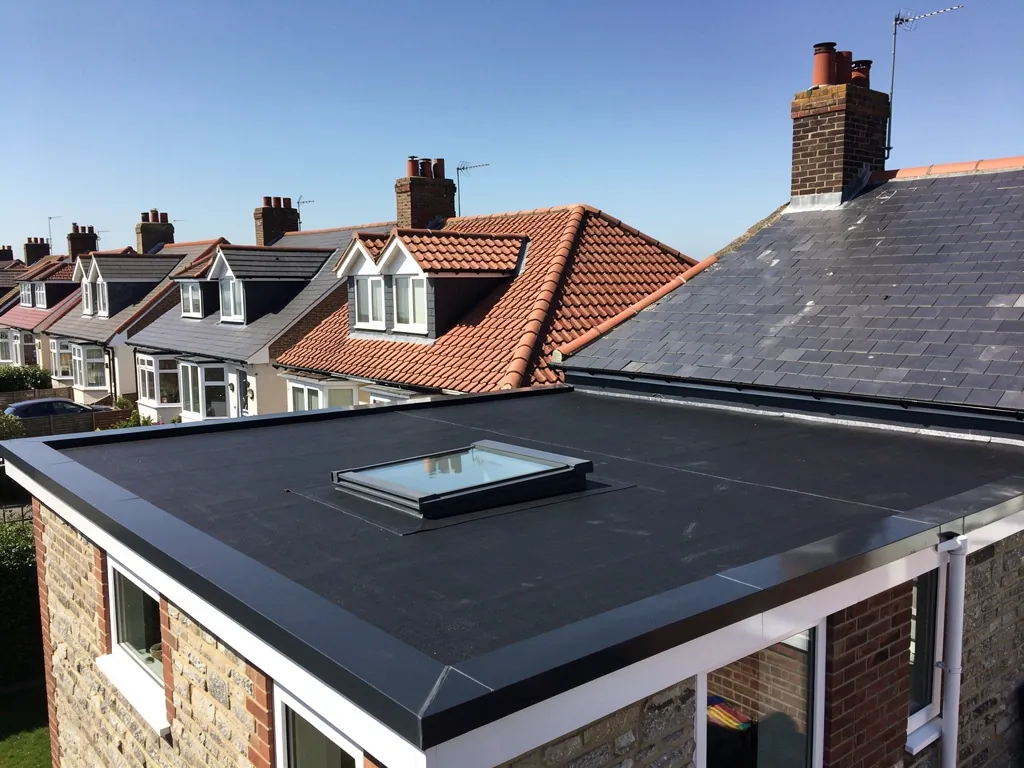
EPDM rubber
One large sheet with very few joins, quick to lay on a simple rectangular roof.
GRP fibreglass
Laid wet and cured hard, with moulded trims that suit balconies and awkward shapes.
1:80
Minimum finished fall for flat roofs, BS 6229:2025
4.2 Lead and flat roof coverings
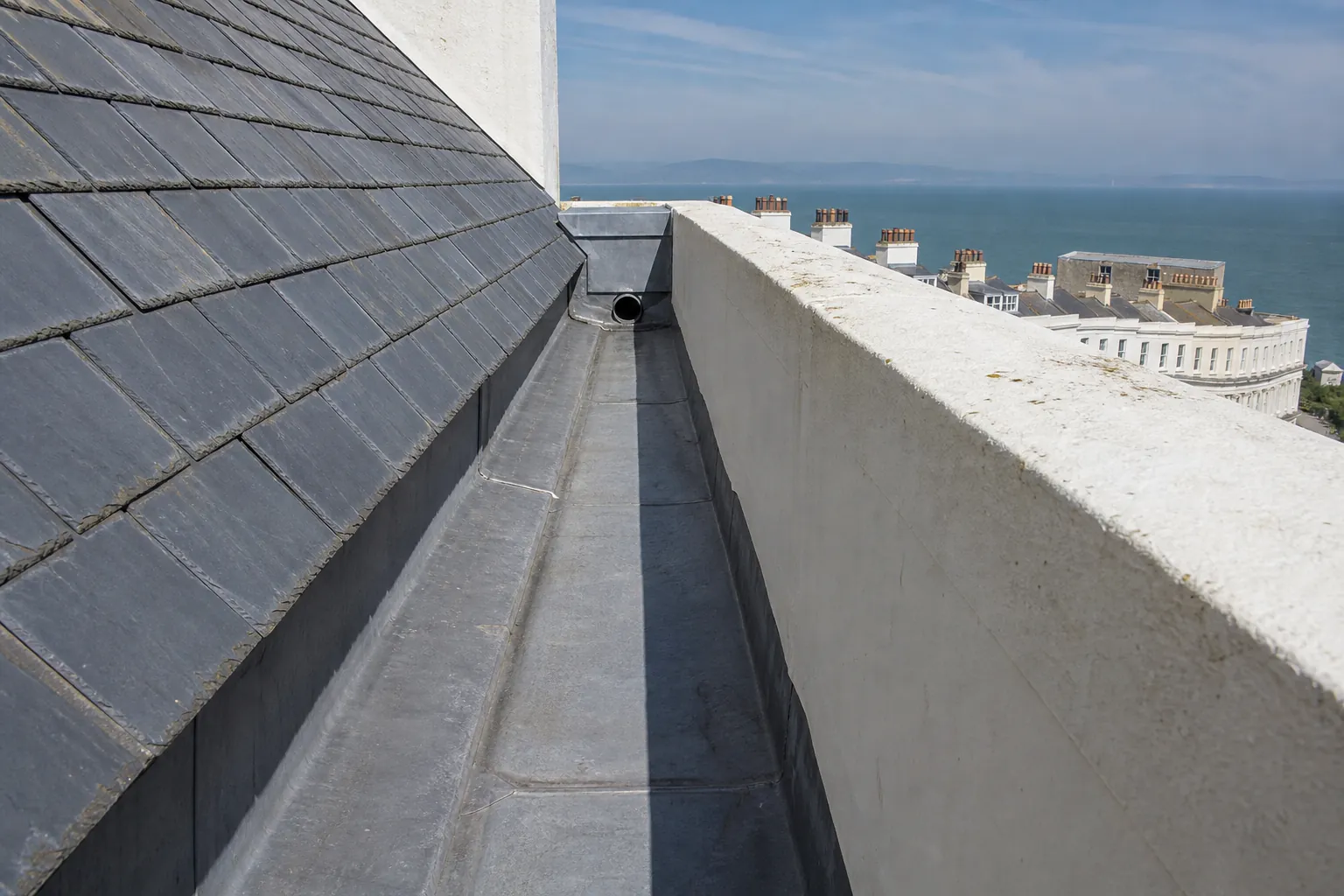
Lead sheet is graded by code, from code 3, which Royston Lead recommends for soakers only (the small lead pieces woven between tiles where a slope meets a wall), up to code 8. Royston rates code 4 for soakers, flashings, valleys and dormers, with codes 5 and 6 also suited to box and parapet gutters. Lead flashing can last over 80 years, according to MyJobQuote. On a flat roof, Less gives torch-on felt 10 to 20 years and GRP, glass-reinforced plastic, 25 to 40 years, while GreenSpec puts EPDM, a synthetic rubber membrane, at 20 to 30 years. Whatever the covering, roofers design a flat roof to a fall of around 1:40 so that the finished surface still drains.
Chapter 5: When a re-roof or new roof is the answer2440
Sheet 05 / 08A full replacement is worth it when the whole roof is failing rather than one part, and this is how we judge it.
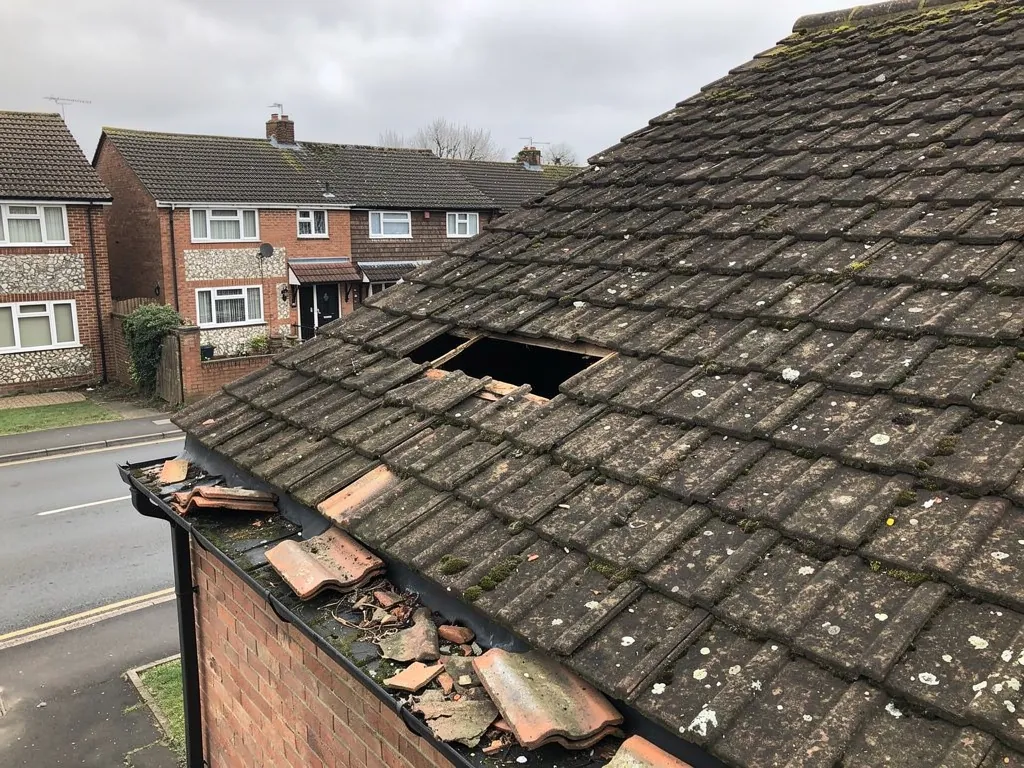
Replacement is one of the biggest decisions a household makes, so we treat it carefully. The test is simple to state: are the faults local, or are the covering, the underlay and the battens wearing out together? Signs of the second include slipped tiles on several slopes at once, battens that are soft when a tile is lifted, underlay that crumbles to the touch and a run of patches that each lasted less time than the one before. One bad slope can sometimes be re-covered on its own. A whole roof in that state needs a roof replacement.
Three outcomes for a tired roof
- Keep repairingFaults are isolated and the battens and underlay are still sound.
- Re-cover a slopeOne elevation has failed while the other slopes still have years left.
- Full re-roofBattens, underlay and covering are failing together on every elevation.
5.1 What a re-roof involves
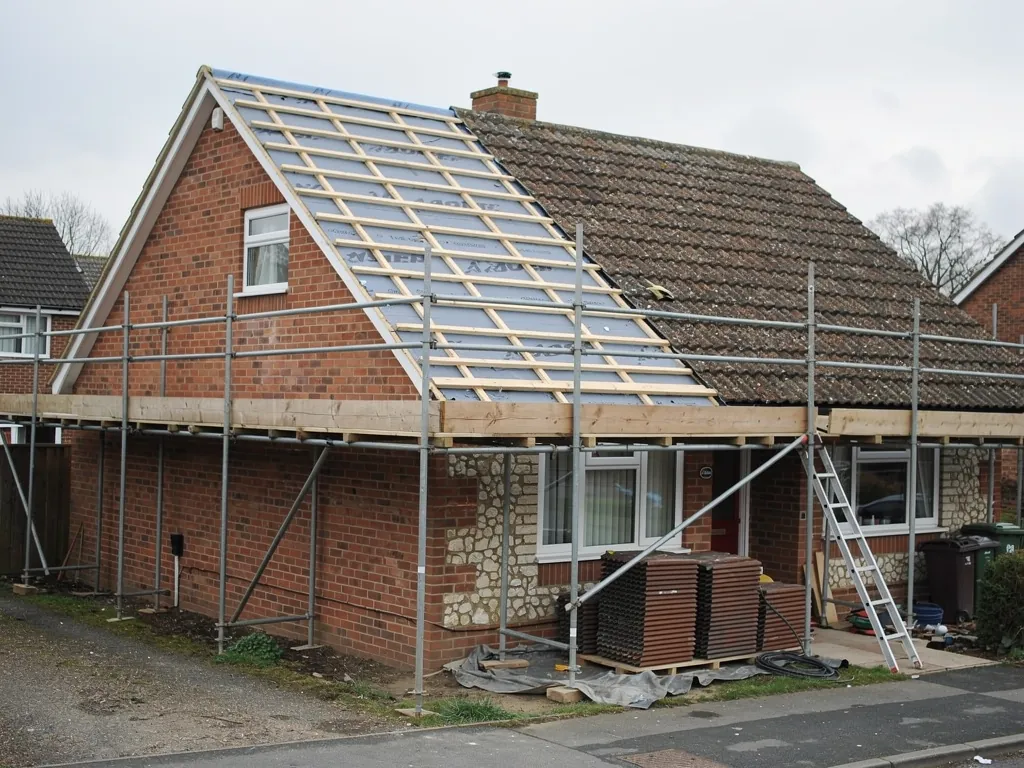
We strip the old covering to the rafters, check and repair the timbers, then lay new underlay and new treated battens. The tiles or slates go back with the fixings the current code of practice calls for, the ridge and hips are mechanically fixed, and the verges are finished with dry verge units or bedded and fixed. The lead flashings at chimneys and walls are renewed in the right code. Sound old tiles or slates can sometimes be reused on the front slope to keep the look of the street. Before stripping starts the roof is checked for bats and nesting birds, which are protected by law, and the job ends with clear gutters, the site cleared and the waste taken away.
5.2 Building Regulations on a new roof
The Planning Portal says a building control application is not normally needed where less than 25 per cent of the total building envelope and less than 50 per cent of the roof is affected. Arun District Council’s building control page lists replacing roof coverings among the work that needs approval, so read the two together and let us confirm what applies to your job. The Planning Portal adds that a new covering 15 per cent or more heavier than the old one needs approval, and a re-roof can mean upgrading the insulation under Part L. Where the work is notifiable, we handle the notification.
A new roof on an extension or a new build is a different job: there is no old covering to match, so the choice comes down to pitch, weight and the look of the street. Every tile has a minimum pitch on its data sheet. Marley’s concrete plain tile needs 35 degrees, while some of its interlocking tiles are rated down to 15 degrees or, in one case, 12.5.
A new roof should be the answer to a worn-out roof, never to a single leak.
Chapter 6: What roof work costs, and what moves it2379
Sheet 06 / 08£12,000
Checkatrade typical re-roof, three-bedroom semi, October 2026
National cost guides give a sense of scale; the real figure for your roof depends on access, covering, size and what the survey finds.
Our guide ranges for common jobs sit in the table further down this page. To put them in context, here is what national cost guides published in 2026 say about typical UK prices. Read them as a sense of scale rather than a quote: they are averages across the country, some are shown before VAT, and VAT is charged at the standard rate of 20 per cent. Prices near the coast follow the same drivers as anywhere else: the size of the job, the access, the covering and how much the survey uncovers. The guide on roof work costs in the UK goes through every job in more detail.
Typical UK replacement prices
- Flat roof replacement£2,800 to £7,500
- Gable roof replacement£7,000 to £16,250
- Hip roof replacement£9,250 to £18,000
- Scaffold for a re-roof£700 to £1,300
National markers only; once we have seen your roof, the written quote gives one total.
Source: Checkatrade roof replacement cost guide, table last updated October 2026, prices plus VAT
6.1 Repairs by the square metre
Checkatrade’s roof repair guide (table last updated June 2026, excluding VAT) prices repairs by area: roughly £90 to £120 per square metre on concrete tiles, £110 to £160 on clay and £150 to £220 on natural slate, with EPDM flat roof repairs at £120 to £170. Ridge tile repairs and lead flashing repairs each run at about £50 to £70 per metre in the same guide. A few slipped tiles on a bungalow reached from a ladder sit at the bottom of any range; a chimney flashing renewal on a three-storey terrace that needs a scaffold sits near the top. Slate costs more per metre to repair, but slate that is refixed properly can stay on the roof for generations.
6.2 Access, scaffold and VAT
Access moves the price more than anything else on a small job. A two-storey semi usually needs a scaffold, which Checkatrade puts at around £875 a month, and where it stands on the pavement a licence is needed under section 169 of the Highways Act. West Sussex County Council asks for 10 working days’ notice and charges £266 for one month. When you compare quotes, check whether each includes VAT and scaffolding. Our prices are good and fair, and the written price after the survey is one total for the whole job.
A very low quote deserves a second look rather than a quick yes. It may leave out the scaffold, assume the battens are sound without anyone checking, or plan to bed a ridge in mortar alone. Ask what the price covers, in writing, before you sign anything. A quote that names the materials and the fixing method is far easier to judge than a bare figure.
Chapter 7: Chimneys, flashings, guttering and the roofline2867
Sheet 07 / 08Gutters and fascias are the drainage of a roof, and they fail quietly until a wall is wet.
From the street
Binoculars from the pavement will show cracked flaunching, missing pointing and lifted lead without anyone climbing a ladder.
The edges are small parts of a roof, but a failed flashing or blocked gutter can soak a wall as fast as a missing tile.
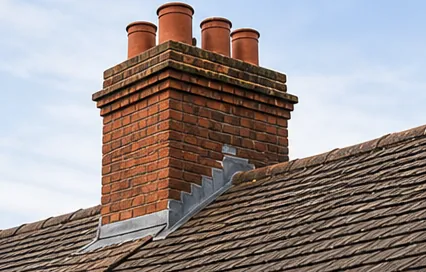
Chimneys stand proud of the roof and take weather from every side, so they need looking at more often than the slopes around them. On the seafront terraces the stacks belong to the street scene, so we repair them rather than remove them. A stack has three common weak points: the brick joints, the flaunching (the sloped mortar collar that holds the pots and sheds water off the top) and the lead where the stack passes through the roof. Our chimney repairs page covers rebuilding and capping as well.
7.1 Repointing and lead work on chimneys
Repointing means raking out weathered mortar between the bricks and filling the joints again, which keeps rain out of the brickwork and stops the top courses working loose. The lead work around the base is a set of pieces: an apron across the front, soakers or stepped flashings down the sides and a back gutter behind the stack. Each is tucked into a cut joint in the brickwork and dressed down onto the tiles. When the quality of that dressing is poor, water tracks behind it and appears as a stain on the chimney breast indoors. Removing a chimney breast always needs Building Regulations approval, and on a party wall a party wall notice as well. Our leadwork page explains the codes.
7.2 Guttering, fascias and soffits
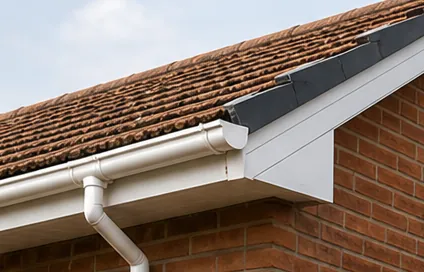
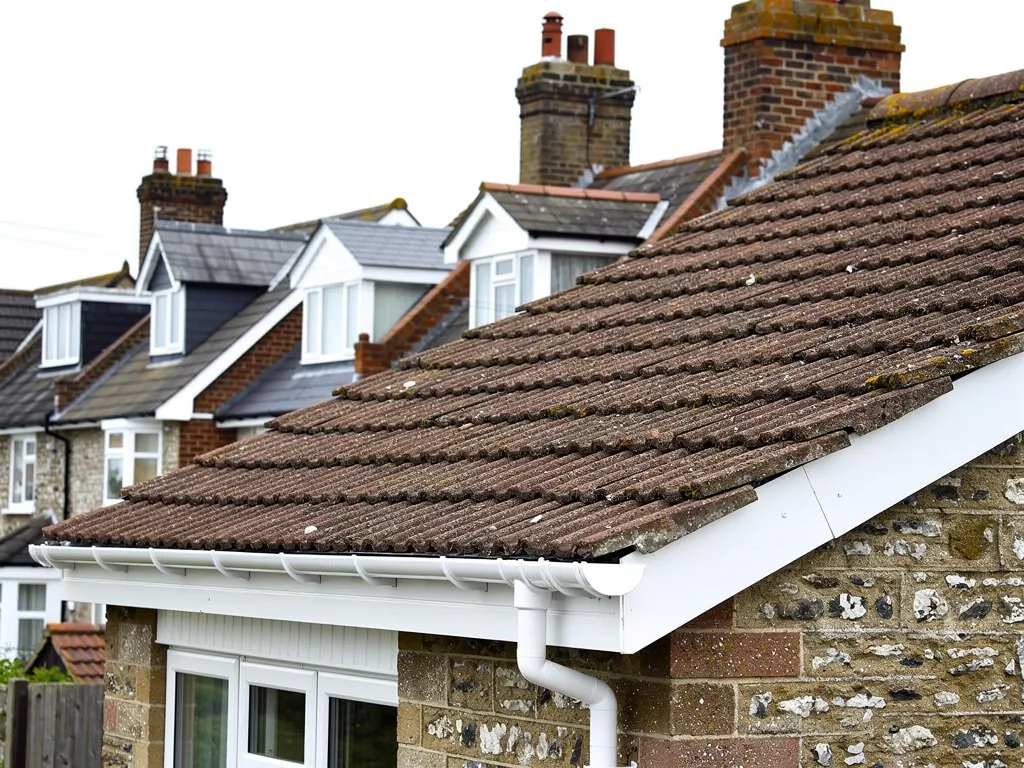
The fascia is the board along the eaves that carries the gutter; the soffit is the panel beneath it that closes the gap back to the wall. With the guttering they move water away from the walls, and when a gutter sags or an outlet blocks, water spills down the brickwork and rots the fascia behind it. Gutters need a slight fall to the outlet, set by each manufacturer: Brett Martin asks for 1 mm in every 600 mm. Checkatrade notes that when fascias and soffits need replacing varies with upkeep and the material. Old soffit boards can be asbestos insulating board, which the HSE says is mostly licensed work, so we test suspect boards before anything is cut.
Chapter 8: Domestic and commercial roofs, and the permissions3050
Sheet 08 / 08Homes, rented flats, shops and units all get the same survey, but the rules around them differ, and we check those before quoting.
We work on domestic roofs, from one slipped tile on a bungalow to a full re-roof on a seafront terrace, and on commercial roofs for landlords, shops, offices and small industrial units. A reliable roof matters even more on a business, where a leak can close a shop floor or spoil stock, so commercial roofing work is planned around opening hours, with access agreed in advance. Blocks of flats with a shared flat roof sit between the two.
Checked before we quote
- Listed status of the building
- Conservation area boundaries
- Share of the roof affected
- Weight of any new covering
- Scaffold on the public highway
8.1 Commercial and rented property
Commercial buildings around Bognor and Littlehampton often carry large flat roofs, older profiled sheeting or a mix of the two. On a large flat roof we look first for ponding water and split seams at the upstands, the turned-up edges where the covering meets a wall. Fibre cement sheeting from before 2000 may contain asbestos cement. The HSE treats careful removal of asbestos cement that is not broken up as non-licensed work, and once it is substantially damaged or breaking up the work becomes notifiable. The HSE also says asbestos cement roofs are always fragile, so nobody stands on one without crawl boards and edge protection. For landlords and managing agents, the survey photographs and the written quote come in a form you can pass on to tenants or freeholders.
8.2 Planning, listed buildings and dormers
Like-for-like re-roofing does not usually need planning permission, because it does not materially change how the building looks. Listed buildings are the exception: check any work on one with the council first, as listed building consent may be needed. Arun’s Article 4 directions in Bognor, one on houses in multiple occupation and one on verges and hard surfaces at Craigweil, remove no roof rights. A new dormer is a bigger step. In a conservation area, the South Downs National Park or Chichester Harbour National Landscape (formerly an Area of Outstanding Natural Beauty), a new dormer is never permitted development and needs planning permission. Elsewhere, Class B can allow one on an ordinary house within set size limits.
Where a job needs consent or a Building Regulations notification, we tell you before you commit and build the timing into the plan. If you are unsure whether your home is listed or inside a conservation area, we check the address for you. Our guide to roof work regulations sets out the thresholds and the consent routes in full, including who decides inside the South Downs.
Areas
Roofers across Bognor Regis, Littlehampton and West Sussex
Map of the area we cover: a dashed circle 25 miles across the crow-flies from Bognor Regis takes in the towns we serve within 30 road miles.
Get a quote
Tell us what your roof is doing
Send a photo of the problem, or describe where water is getting in, and we will arrange a survey and a written price.
Loading the enquiry form. You can also call 01243 252373.
Guide prices
JJ Roofing guide prices
| Job | Guide price |
|---|---|
| Roof repairs | £100 to £1,000 |
| Flat roofing | £1,000 to £5,000 |
| Pitched roof | £5,000 to £12,000 |
| Chimney repairs | £300 to £3,000 |
| Guttering, soffit and fascia replacement | £500 to £2,000 |
Ranges drawn from our own work on roofs across the area, then confirmed for your home by the survey.
Guides and answers
Guides for Bognor Regis homeowners
Plain-English guides to costs, permissions, insurance and choosing a roofer, written for homes on this stretch of the Sussex coast.
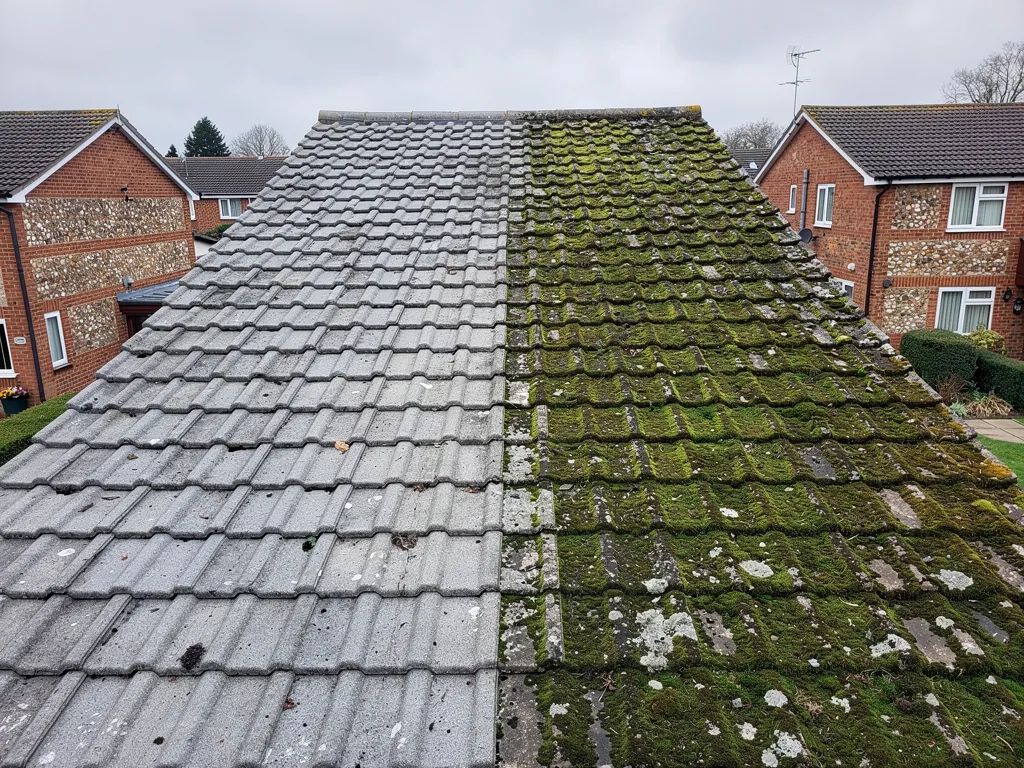 Hiring a roofer: what happens from the first call to the final check9 min read
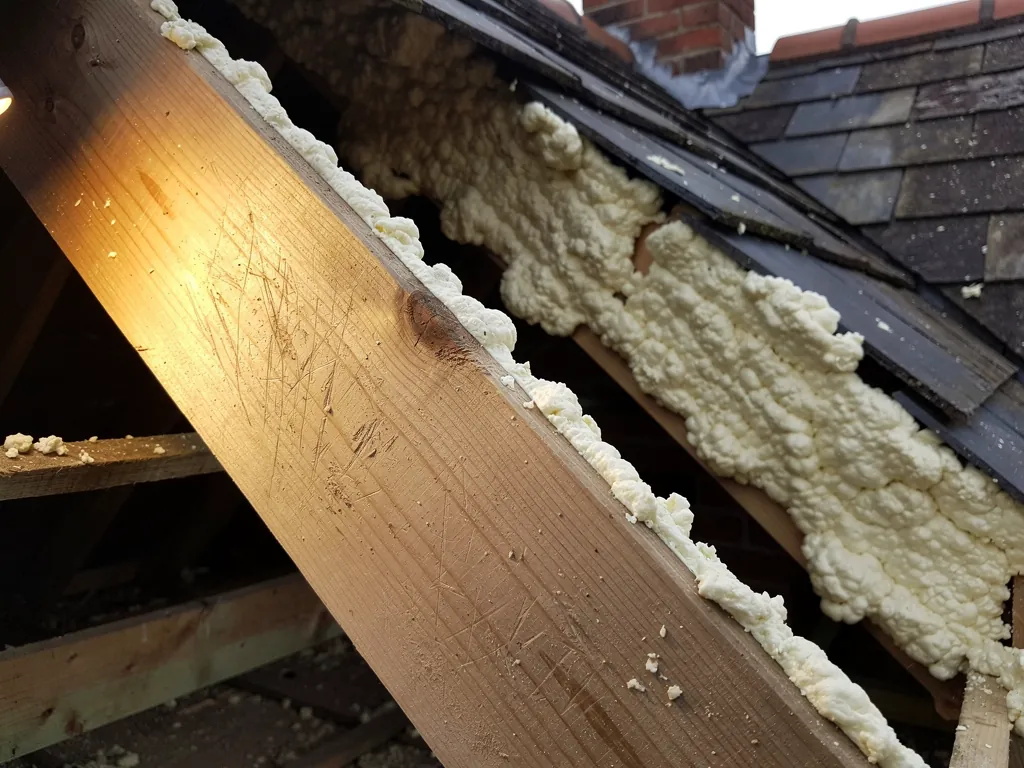 How can you tell a dodgy roofer? The warning signs to look for9 min read
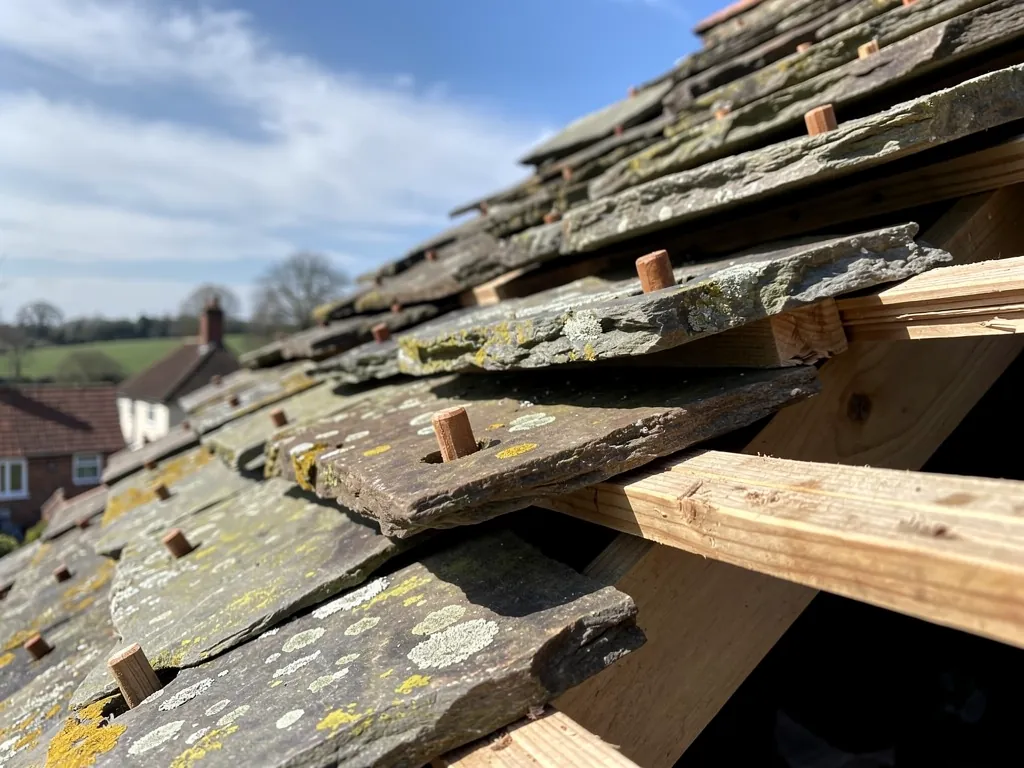 What does roof work cost in the UK? A guide to typical prices9 min read
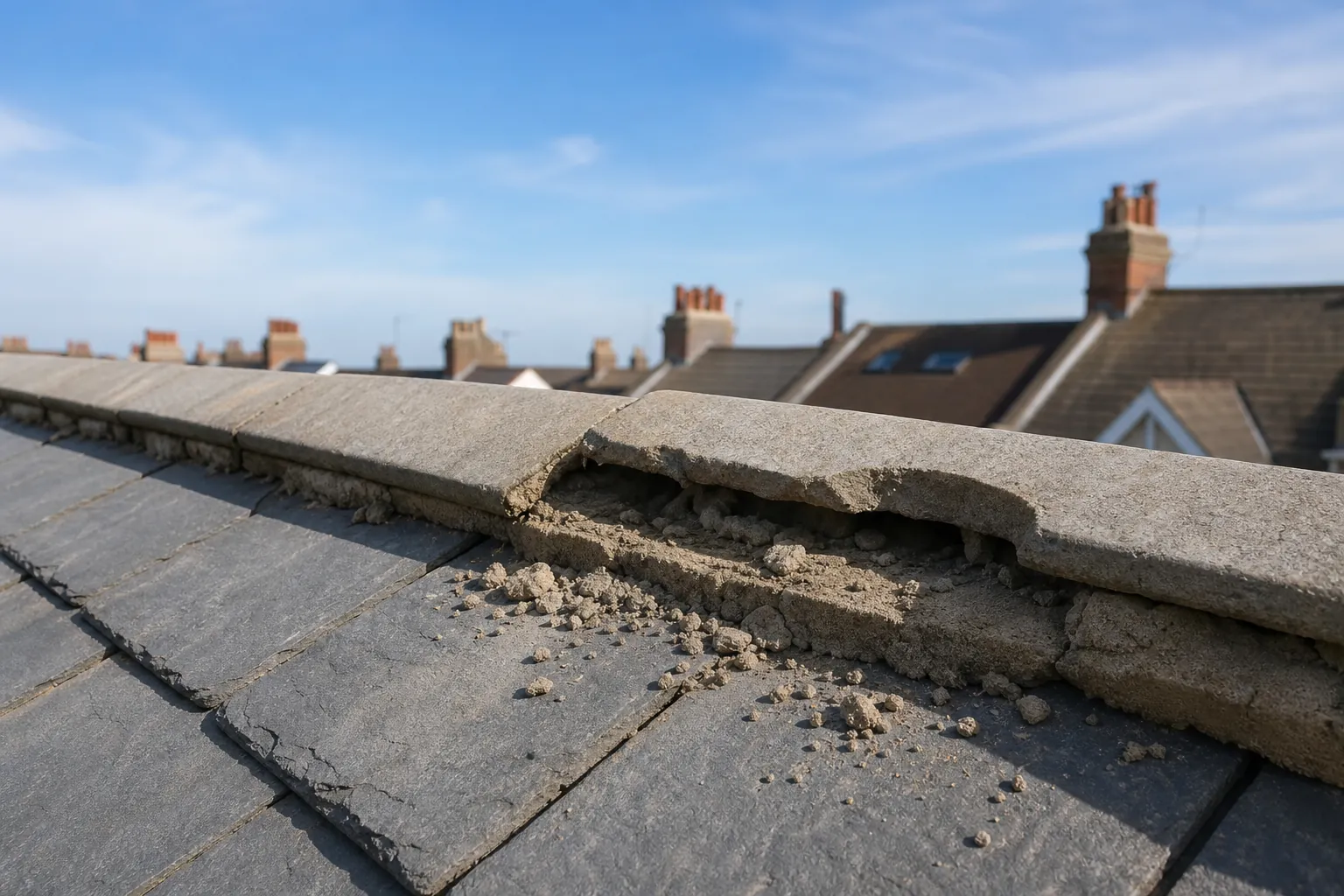 Roof work and the rules: Building Regulations, planning and consent explained9 min read
 Do you need planning permission for roof work?9 min read
 Making a roof insurance claim: storms, wear and tear and what insurers ask for9 min read
 Buying a house: the roof checks to make before you exchange9 min read
 A seasonal roof maintenance checklist for homes on the Sussex coast9 min read
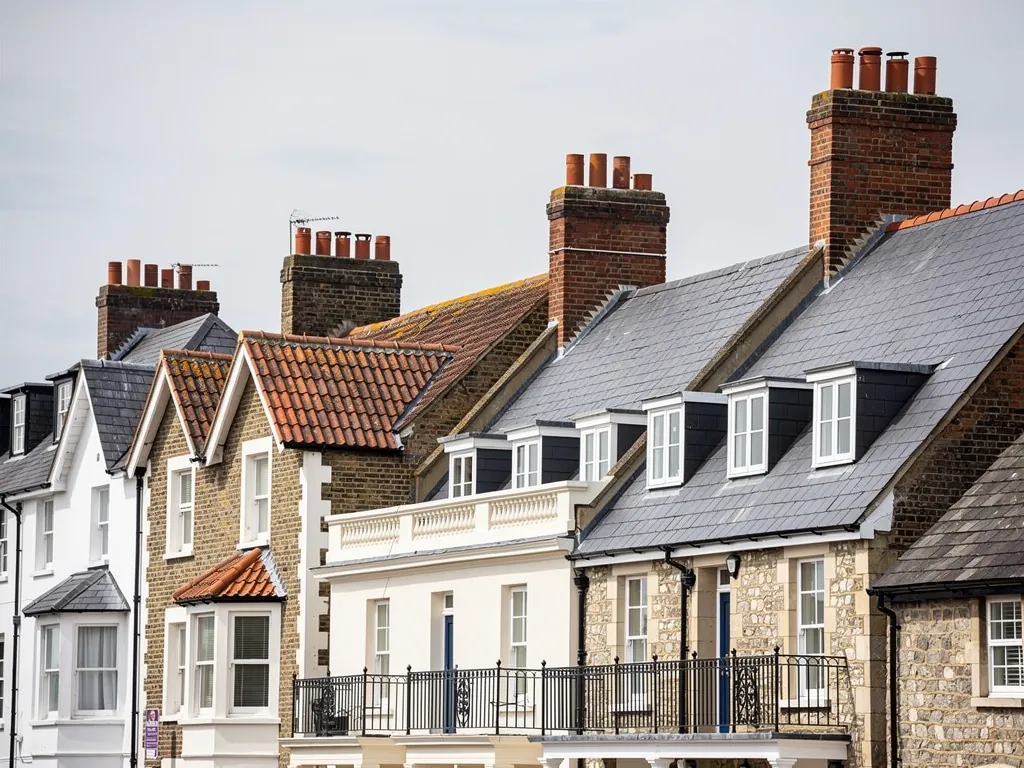 Bognor Regis houses and their roofs: Regency terraces to post-war bungalows9 min read
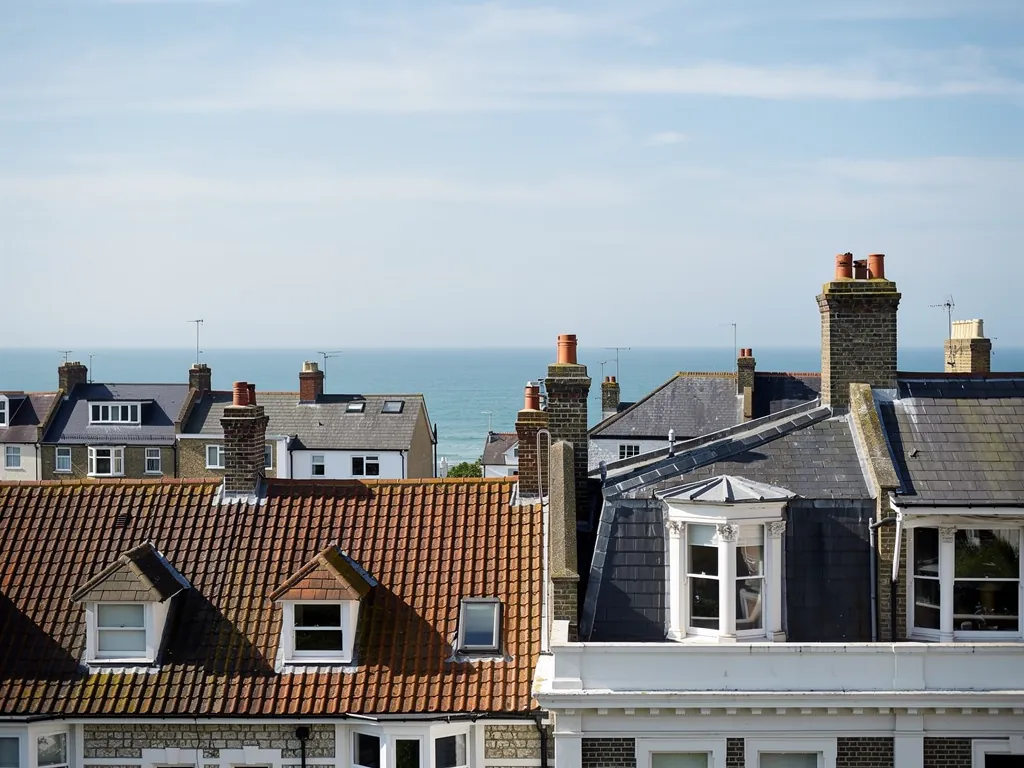 Living by the sea: how coastal weather affects your roof9 min read
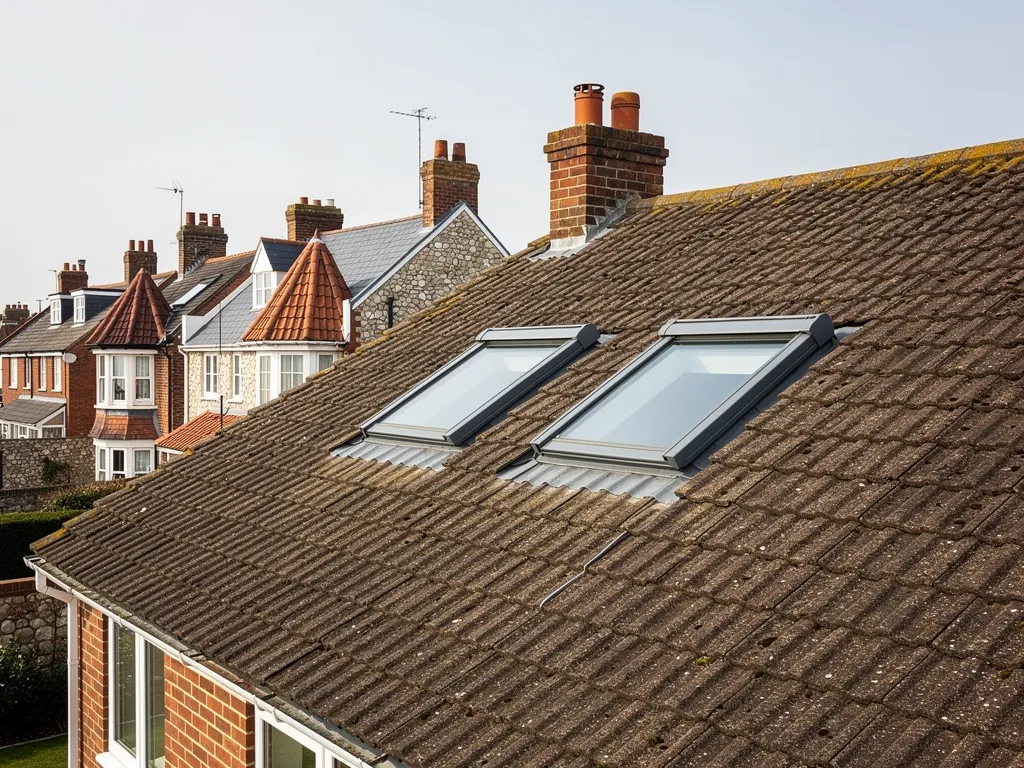 Chalet bungalow roofs: repairs, dormers and re-roofing on seaside bungalows9 min read
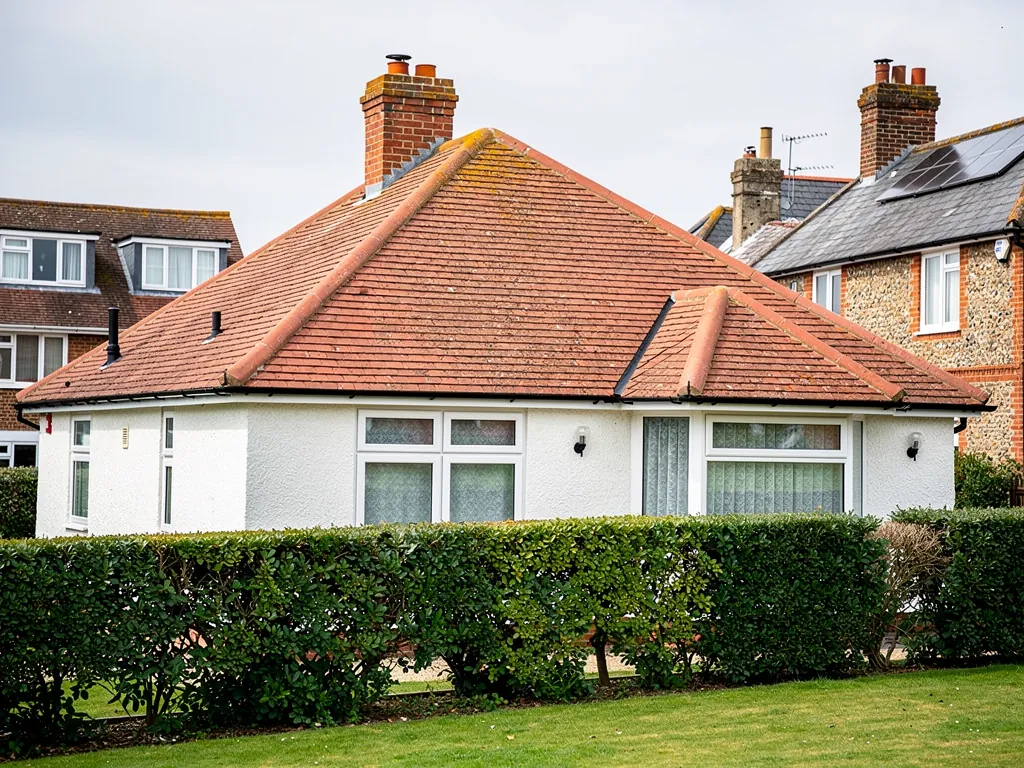 Roof work in Bognor Regis conservation areas: The Steyne, Aldwick Road and more9 min read
Quick answers
- How much does a roofer charge per day or per hour?
- Can you get a government grant for a new roof?
- How can I find a good roofer?
- What should you ask a roofer before you hire them?
- How many roofing quotes should you get?
- Should you pay a roofer a deposit?
- A roofer knocked on my door saying my roof needs work: what should I do?
- Can you cancel a roofing contract? The 14-day cooling-off period
- How do you complain about a roofer?
- Do you pay VAT on roofing work?
- Should you hire a roofer or a builder?
- Why hire a local roofer rather than a national firm?
- Can roofers work in winter and in the rain?
- Do you need a scaffold licence for roof work in West Sussex?
- Arun building control: who checks roof work in Bognor Regis?
- Roof work in the South Downs National Park: who decides?
- Roof work near Chichester Harbour National Landscape: what changes?
- Do bats in the roof stop roof work?
- Can roof work go ahead if birds are nesting?
- Roofing terms explained: a plain-English glossary
Questions
Roofing questions, answered plainly
How can you tell a dodgy roofer?
Warning signs include a knock on the door right after a storm, pressure to decide today and a request for most of the money up front. Check any roofer the same way: an address or landline you can verify, a written quote before work starts, photographs of the fault on your own roof and reviews traceable to real jobs. Fake reviews have been banned outright since April 2025.
Can I get a government grant for a new roof?
Usually not. No national scheme pays for re-roofing or roof repairs; the government schemes fund insulation and heating. ECO4 runs only until 31 December 2026, and the Great British Insulation Scheme ended on 31 March 2026. If you are on a low income or disabled, ask Arun District Council what help it offers, and check current schemes on gov.uk first.
How much should a roofer charge per hour or per day?
Checkatrade’s roof repair guide, last updated June 2026, puts UK roofers at around £35 to £45 an hour or £280 to £360 a day, and its slate guide gives slate roofers the same daily range. Roofing is usually priced by the job, with materials, access and scaffold alongside the labour, so compare total prices.
What is the average cost of repairing a roof in the UK?
Checkatrade prices tile and slate repairs at £90 to £220 per m² (June 2026), and Less prices small flat roof repairs at £150 to £500 (March 2026). The range is wide: one slipped tile reached from a ladder at one end, failed flashing on a scaffolded terrace at the other. Our guide range is in the table above, and the survey settles your figure.
How much should a new roof cost in the UK?
Checkatrade’s replacement guide, updated October 2026, gives a UK average of around £8,000 and a typical spread of £4,000 to £19,000. Size, pitch, covering and access drive the difference, so a small flat-roofed extension and a large hipped slate roof sit far apart. When comparing quotes for a new roof, check whether each includes VAT and the scaffold.
How can I find a good roofer?
Start local: ask neighbours who have had similar work done, and look for a real phone number and a named contact. Get two or three written quotes for the same scope, ask each roofer for photographs of the fault, and ask who handles any Building Regulations notification. A good roofer explains the decision in plain words and gives you time to think.
What should I do if a storm damages my roof?
Keep clear of fallen tiles and make the house safe first. Tell your insurer as soon as you can, before any permanent repair, and photograph the damage inside and out. Which? advises keeping receipts for any emergency repair you arrange and keeping damaged items unless they are dangerous. We prioritise leaks and storm damage, and make a leaking roof safe first.
Can I cancel a roofing contract I signed at home?
Usually, yes. A contract agreed in your home, for example after a survey, is an off-premises contract, and you can cancel it within 14 days without giving a reason. To have work start inside those 14 days, you must ask in writing. The right does not cover a visit you requested specifically for urgent repairs, though extra work sold on that visit is still covered.